Open by design
Why sharing science is in our DNA
Two opposing truths about modern science were revealed during COVID-19. Researchers collaborated across borders and disciplines at speeds never seen before, delivering vaccines and treatments in record time. Yet those very breakthroughs were locked behind restrictive patents and exclusive supply and pricing deals, leaving billions of people waiting.
This contradiction goes to the heart of the shared conviction that drives our partnerships at DNDi: the raw material of every new medical innovation is knowledge. When knowledge is shared instead of fenced in, science moves faster, costs less, and reaches more people who need it.
The cost of privatizing knowledge
Open science is not a new idea. Landmark collective achievements like the Human Genome Project, which released its data within 24 hours of it being generated, show its power. On the flip side is the enclosure of knowledge: undisclosed results and dense webs of patents, confidentiality clauses, and trade secrets that can wall off discoveries from researchers who might build and improve on them.
Patents reward inventors for disclosing their work and give them time to recoup their investment. But they come with a trade-off: for at least 20 years, no one else can use the protected knowledge without permission. Too often
in global health, knowledge is locked away, limiting or preventing scientific collaboration, follow-on research, production, and equitable access to life-saving health tools.
A spectrum of openness
In developing our very first institutional policy – our Intellectual Property Policy, written at our founding in 2003 – we inverted the usual logic: instead of treating research as closed unless someone argues to open it, we treat it as open unless there is a specific, compelling reason not to.
In our collaborations with partners, we have shown that open science is not a single rule but a spectrum of potential arrangements that can be tailored to the goals and realities of each alliance.
At the fully open end sits the COVID Moonshot, a global grassroots movement of scientists we joined at the height of the pandemic. It asked chemists worldwide to help design molecules to block the virus – expecting a few hundred ideas but receiving more than 18,000. Every result was published immediately, free of patents, with the aim of identifying an affordable generic that anyone could make.
ASAP-0017445, an antiviral that grew directly out of the Moonshot, is now advancing through the AI-driven ASAP consortium – with partners including Diamond Light Source, Memorial Sloan Kettering Cancer Center, PostEra, and Stanford University. It has shown promise against SARS-CoV-2, MERS, and related coronaviruses, and in 2025 was formally nominated as a candidate to move towards first-in-human trials.
The compound’s significance reaches beyond any single disease: it is a working blueprint for how intellectual property can be used to enable equitable access rather than restrict it. Moonshot exposed an unexpected problem for open science: because no one owned Moonshot’s compounds, no manufacturer or funder wished to invest in their development for fear that a competitor could swoop in, patent a small change to a molecule, and seize control. That drove DNDi and our partners towards a breakthrough idea: use a patent not to lock a medicine down, but to keep it free.
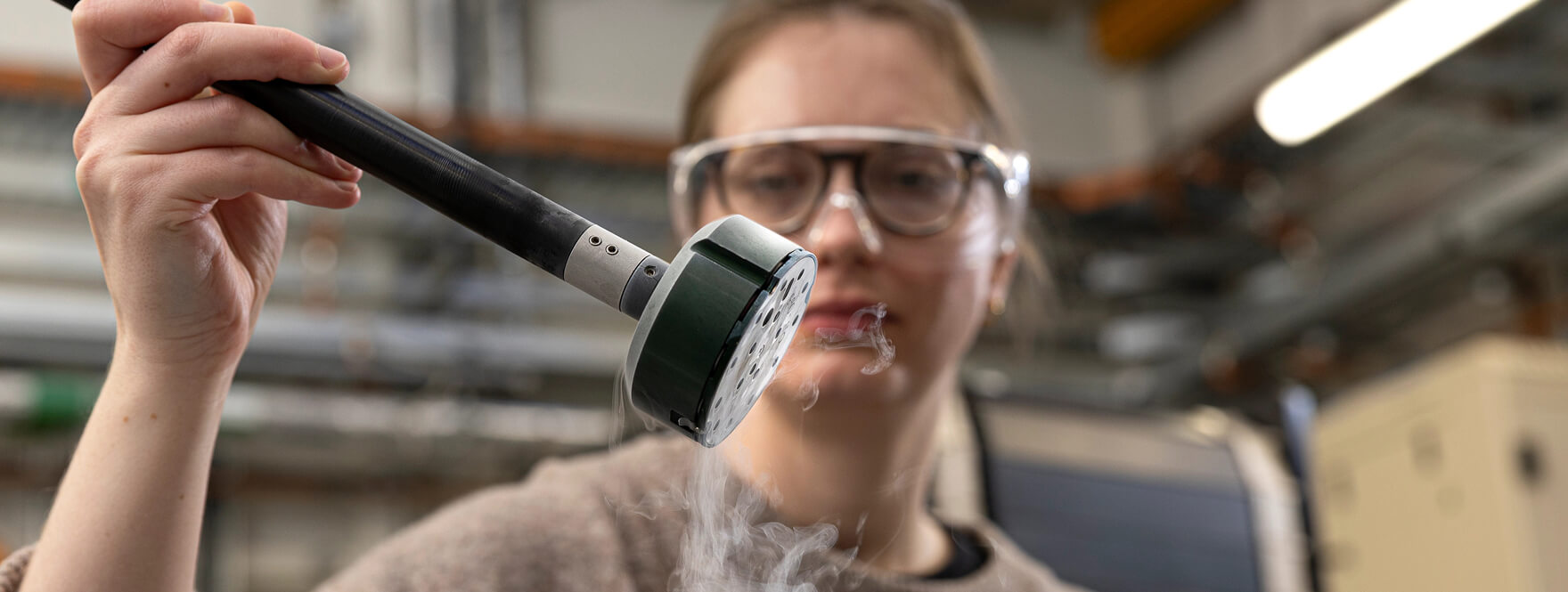
Researcher JASMIN ASCHENBRENNER works in the laser crystallography laboratory at Diamond Light Source, Oxford, UK, a partner in the COVID Moonshot and the ASAP Drug Discovery Consortium, both open-science collaborations focused on discovering and developing new medicines for viruses of pandemic potential.
We filed what we call a ‘minimally defensive, maximally permissive’ patent: minimally defensive because it claims only what is needed to prevent anyone else from monopolizing the compound, and maximally permissive because it is paired with open, non-exclusive licensing that allows multiple manufacturers to make the medicine. In 2025, we published the patent far faster than the usual 18-month norm and released the molecule’s structure openly so scientists everywhere could build on it.
Further along the spectrum lies ravidasvir, the first hepatitis C drug to be developed through South-South collaboration. It was originally discovered by Presidio Pharmaceuticals, which held patents in selected high- and middle-income countries. In 2016, DNDi signed a non-exclusive licence with Presidio and Egypt’s Pharco Pharmaceuticals to test ravidasvir in combination with sofosbuvir, another direct-acting antiviral. Crucially, every partner committed to equitable access from the start: Presidio granted full freedom to operate in the field of hepatitis C, and Pharco committed to affordable pricing and sharing its manufacturing process, as well as the possibility of technology transfer to local manufacturers.
Our shared goal was a hepatitis C cure that patients could afford. At the time, existing treatments were priced at nearly USD 100,000 in some countries. DNDi coordinated a Phase II/III study in Malaysia and Thailand, co-sponsored by the two countries’ health ministries. Malaysia approved the combination in 2021 at USD 300-500 per 12-week treatment course. Thailand registered the treatment in early 2026, and registration is also underway in Brazil.
Proof from our experience
These are two of many examples of open science collaboration detailed in our policy report, Open Science in a Closed World (read more) – one of the first comprehensive looks at how openness can be operationalized in real-world R&D collaborations. It explores the tensions and trade-offs between open science and more traditional, proprietary research models, presents a practical framework for embedding openness and equitable access across the innovation lifecycle, and provides actionable recommendations on how governments, R&D funders, academia, and industry can operationalize openness and equity in their innovation policies, practices, and partnerships.
The open-science principles behind our R&D partnerships could reshape medical innovation if widely adopted. That will take real change: funders rewarding openness over secrecy, academia moving beyond IP as a main measure of productivity, and global health actors building equitable access into their agreements from the start.
We are grateful to our partners for continuing to prove that when science is open by design, it is not a constraint on innovation but a driver – and a foundation for health equity.
More 2025 highlights:
Photo credit: Stuart March-DNDi.
Stay connected
Get our latest news, personal stories, research articles, and job opportunities.