
• DNDi_Logo_No-Tagline_Full Colour
  • Our work
    • Diseases
      • Sleeping sickness
      • Visceral leishmaniasis
      • Cutaneous leishmaniasis
      • Chagas disease
      • Parasitic worms
      • Mycetoma
      • Dengue
      • Paediatric HIV
      • Cryptococcal meningitis
      • Hepatitis C
      • Pandemic preparedness
      • Antimicrobial resistance
    • Research & development
      • R&D portfolio & list of projects
      • Drug discovery
      • Translational research
      • Clinical trials
      • Registration & access
      • Treatments delivered
    • Advocacy
      • Open and collaborative R&D
      • Transparency of R&D costs
      • Pro-access policies and IP
      • Children’s health
      • Gender equity
      • Climate change
      • AI and new technologies
  • Networks & partners
    • Partnerships
      • Our partners
      • Partnering with us
    • Global networks
      • Chagas Platform
      • Dengue Alliance
      • HAT Platform
      • LEAP Platform
      • redeLEISH Network
    • DNDi worldwide
      • DNDi Switzerland
      • DNDi Eastern Africa
      • DNDi Japan
      • DNDi Latin America
      • DNDi North America
      • DNDi South Asia
      • DNDi South-East Asia
      • DNDi West and Central Africa
  • News & resources
    • News & stories
      • News
      • Stories
      • Statements
      • Viewpoints
      • Social media
      • eNews Newsletter
    • Press
      • Press releases
      • In the media
      • Podcasts, radio & TV
      • Media workshops
    • Resources
      • Scientific articles
      • Our publications
      • Videos
    • Events
  • About us
    • About
      • Who we are
      • Our story
      • How we work
      • Our strategy
      • Our donors
      • Annual reports
      • Our prizes and awards
    • Our people
      • Our leadership
      • Our governance
      • Contact us
    • Work with us
      • Working at DNDi
      • Job opportunities
      • Requests for proposal
  • Donate
  • DNDi_Logo_No-Tagline_Full Colour
  • Our work
    • Diseases
      • Sleeping sickness
      • Visceral leishmaniasis
      • Cutaneous leishmaniasis
      • Chagas disease
      • Parasitic worms
      • Mycetoma
      • Dengue
      • Paediatric HIV
      • Cryptococcal meningitis
      • Hepatitis C
      • Pandemic preparedness
      • Antimicrobial resistance
    • Research & development
      • R&D portfolio & list of projects
      • Drug discovery
      • Translational research
      • Clinical trials
      • Registration & access
      • Treatments delivered
    • Advocacy
      • Open and collaborative R&D
      • Transparency of R&D costs
      • Pro-access policies and IP
      • Children’s health
      • Gender equity
      • Climate change
      • AI and new technologies
  • Networks & partners
    • Partnerships
      • Our partners
      • Partnering with us
    • Global networks
      • Chagas Platform
      • Dengue Alliance
      • HAT Platform
      • LEAP Platform
      • redeLEISH Network
    • DNDi worldwide
      • DNDi Switzerland
      • DNDi Eastern Africa
      • DNDi Japan
      • DNDi Latin America
      • DNDi North America
      • DNDi South Asia
      • DNDi South-East Asia
      • DNDi West and Central Africa
  • News & resources
    • News & stories
      • News
      • Stories
      • Statements
      • Viewpoints
      • Social media
      • eNews Newsletter
    • Press
      • Press releases
      • In the media
      • Podcasts, radio & TV
      • Media workshops
    • Resources
      • Scientific articles
      • Our publications
      • Videos
    • Events
  • About us
    • About
      • Who we are
      • Our story
      • How we work
      • Our strategy
      • Our donors
      • Annual reports
      • Our prizes and awards
    • Our people
      • Our leadership
      • Our governance
      • Contact us
    • Work with us
      • Working at DNDi
      • Job opportunities
      • Requests for proposal
  • Donate
Home > Diseases
filarial icon

Schistosomiasis

Symptoms, transmission, and current treatments for schistosomiasis

Home > Diseases
filarial icon

Schistosomiasis

Symptoms, transmission, and current treatments for schistosomiasis

What is schistosomiasis?

Also known as bilharzia or snail fever, schistosomiasis is a disease caused by Schistosoma parasitic worms that spread via contaminated freshwater sources, such as rivers, ponds, lakes, and streams. There are different forms of schistosomiasis, depending on which body system is most affected.

The symptoms of schistosomiasis vary depending on the species involved, affecting either the urinary tract or the intestines. Urinary schistosomiasis, caused primarily by Schistosoma haematobium, can lead to blood in the urine, frequent or painful urination, and, in chronic cases, damage to the bladder and kidneys, potentially increasing the risk of bladder cancer. It can also result in female genital schistosomiasis (FGS), a neglected manifestation that affects the reproductive tract and can cause vaginal bleeding, pain, and infertility, with broader implications for sexual and reproductive health.

Intestinal schistosomiasis, typically caused by S. mansoni or S. japonicum, may result in abdominal pain, diarrhoea, and blood in the stool. Chronic infection can progress to liver damage, spleen enlargement, and portal hypertension. Both forms of the disease can lead to long-term complications, including fibrosis (scarring) of the affected organs.

What is the impact of schistosomiasis?

  • Over 250 million people are at risk
  • Over 185 million people are infected
  • Over 11,000 people die from the disease every year
  • 91% of affected people live in Africa
  • 78 countries are endemic for schistosomiasis
  • Up to 56 million women and girls are living with female genital schistosomiasis

What are the current treatments for schistosomiasis?

The current treatment for schistosomiasis is praziquantel, which is most often distributed in mass drug administration campaigns that treat entire communities. But it has limitations: the drug mainly kills adult worms and is less effective against juvenile worms, requiring retreatment over many years, and there are early signs of drug resistance. Praziquantel is also only partially effective in treating female genital schistosomiasis as it kills adult worms and does not relieve the painful symptoms caused by inflammatory reactions to the parasite’s eggs.

What new treatments for schistosomiasis are needed?

New treatments that can kill both adult and juvenile worms are needed. And these treatments need to be suitable for all people at risk – including young children and pregnant women.

For female genital schistosomiasis, new combination treatments – starting with existing drugs – are needed to effectively relieve its debilitating symptoms in both women and girls. These treatments need to be safe, affordable, and accessible for all who need them.

What schistosomiasis treatments are we working on?

We are working to identify a combination treatment of existing drugs to better manage female genital schistosomiasis. We also aim to develop and register new safe, affordable, and field-adapted drugs that can kill both adult and juvenile worms in all affected people.

How do you get schistosomiasis?

Entering contaminated freshwater sources – such as rivers, lakes, and ponds – can result in infection as tiny Schistosoma larvae in the water burrow into the skin and migrate to different body systems, where they lay eggs and reproduce. The eggs cause tissue inflammation, often resulting in debilitating symptoms.

The Schistosoma lifecycle is complex. Schistosoma parasites need two different hosts – a freshwater snail and a human – to continue their lifecycle, but they do this very successfully.

  • Adult Schistosoma live in human blood vessels, where the females lay eggs. The urine and faeces of people living with schistosomiasis contain some of the parasite’s eggs.
  • When these eggs come into contact with fresh water, they hatch into tiny free-swimming larvae called miracidia that burrow into freshwater snails.
  • Inside the snail, the miracidia multiply and produce thousands of cercariae – the next larval stage.
  • The cercariae leave the snail and swim through the water in search of a human host.
  • When a human enters the contaminated water, the cercariae burrow into their skin within minutes.
  • Once inside the human body, the cercariae develop into schistosomula. These tiny blood-dwelling worms travel through the bloodstream to the lungs and liver, where they mature into adult worms.
  • Male and female adult worms pair up in the blood vessels around the intestines and bladder, and the female worms begin producing eggs.
  • Some of the eggs leave the human body via urine or faeces, starting the cycle again.
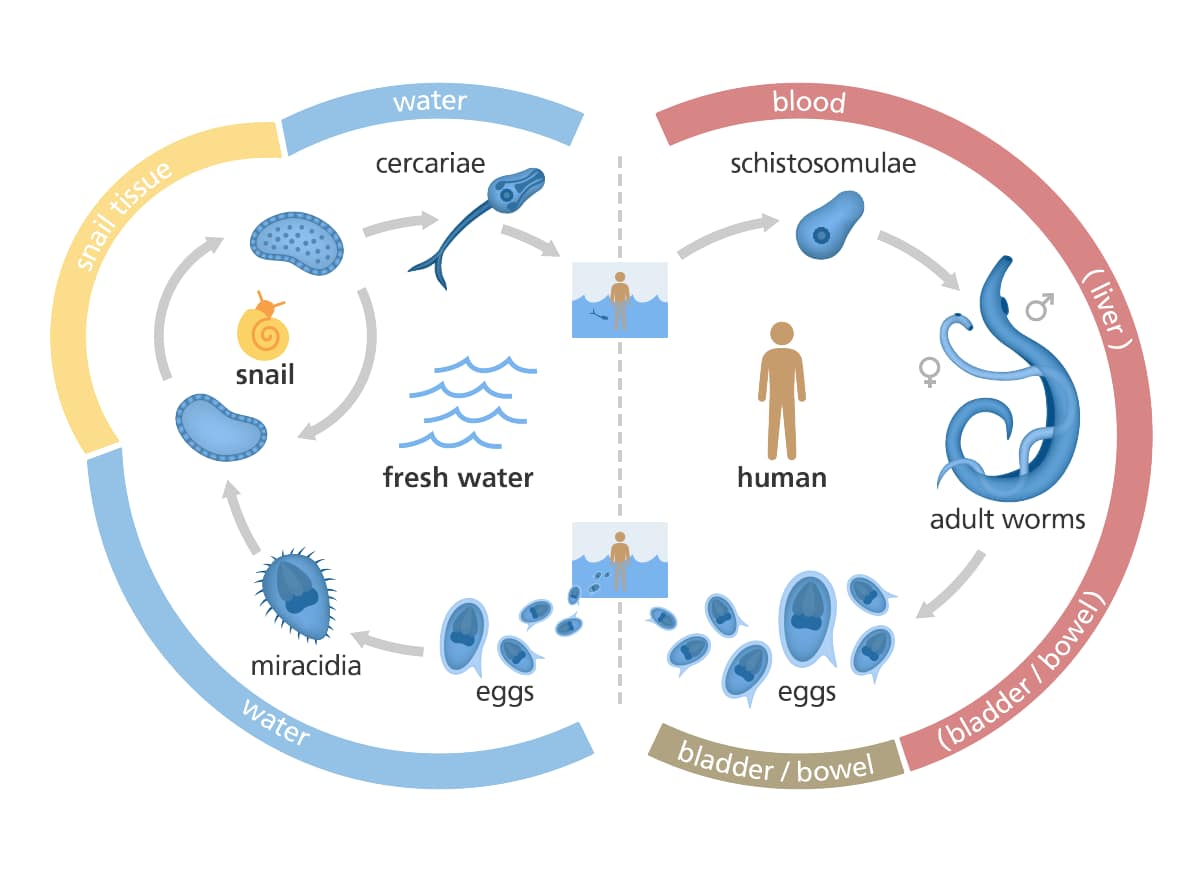
Illustration to show the life cycle of the schistosome parasite. Image credit: Laura Olivares Boldú / Wellcome Connecting Science

What are the symptoms of schistosomiasis?

Schistosomiasis is not often life-threatening, but it can cause long-term suffering and chronic illness.

  • Intestinal schistosomiasis can cause:
    • Abdominal swelling, diarrhoea, and passing blood in stools,
    • Poor absorption of nutrients, anaemia, and lethargy, and;
    • Stunted growth and learning difficulties in children.
  • Urogenital schistosomiasis can cause:
    • Blood in the urine, and
    • Reproductive problems and urogenital pain.
  • Female genital schistosomiasis can cause:
    • Burning, pain, spot vaginal bleeding, bloody discharge, malodorous discharge, stress urinary incontinence, dyspareunia (pain during intercourse),
    • Debilitating morbidity, including adverse sexual and reproductive outcomes such as infertility, miscarriage, and ectopic pregnancy,
    • Increased risk of sexually transmitted infections, including HIV and human papillomavirus (HPV), and
    • Discrimination, stigma, and reluctance to seek treatment due to female genital schistosomiasis symptoms being frequently mistaken for STIs.
  • Schistosomiasis affecting the heart and lungs can cause shortness of breath and coughing up blood.
  • Schistosomiasis affecting the brain and nervous system can cause headaches, weakness, numbness, dizziness, and seizures.

How is schistosomiasis diagnosed?

Schistosomiasis is mostly treated through mass drug administration, so systematic diagnosis is generally not performed. The most commonly used diagnostic methods involve identifying eggs in faeces or urine or detecting circulating anodic antigen in blood. Diagnostic tools and their efficacy vary depending on the Schistosoma species involved and the body system affected. There is an urgent need for better diagnostic tools for female genital schistosomiasis, which is currently diagnosed through specialized gynaecological examinations that are not available in remote or resource-constrained settings. 

More information

  • WHO factsheet
  • Global Schistosomiasis Alliance

Last updated: December 2025

Making medical history for neglected patients

We develop urgently needed treatments for neglected patients and ensure they’re affordable, available, and adapted to the communities who need them

Chagas disease

Causes heart and vital organ damage, after people are bitten by blood-sucking bugs

We delivered the first-ever treatment for children; now we’re searching for new drug candidates and working to boost access to care

Patient medical examination

Cryptococcal meningitis

Without treatment, deadly for thousands of people with advanced HIV

We’re working to improve access to life-saving treatments and developing an easier-to-use formulation

Cutaneous leishmaniasis

Leaves disfiguring, life-long scars that lead to severe social stigma

We’re working to develop safer, shorter treatments for this disabling disease

Dengue

Rapidly spreading climate-sensitive disease with no specific treatment

We’re building a global partnership with dengue-endemic countries to develop a first treatment

Hepatitis C

Millions are left without treatment even though effective drugs exist

We’ve delivered a treatment as simple, safe, and effective as the best drugs available today – at a fraction of the cost 

Mycetoma

Often ends in amputation​, after people get infected from stepping on a thorn

We conducted the world’s first trial for an alternative to current treatments, which are toxic and difficult to administer

Paediatric HIV

Without treatment, half of children die before their second birthday

We’ve developed a strawberry-flavoured treatment to meet the needs of children long neglected by the global HIV response

Healthcare workers in a hospital

Pandemic Preparedness

The COVID-19 pandemic intensified global health inequalities

We’re bringing together partners and accelerating research to prepare for future viral pandemics in low-resource settings

Parasitic worms

Cause debilitating illness, social exclusion, and long-term disability

We’re working across multiple diseases to develop missing cures that can prevent lasting harm

Sleeping sickness

Transmitted by the bite of a tsetse fly and causes severe neurological disorders

We delivered a revolutionary new drug to replace toxic treatments, and have ongoing trials to eliminate this disease

Chagas disease

Cryptococcal meningitis

Cutaneous leishmaniasis

Dengue

Hepatitis C

Mycetoma

Paediatric HIV

Pandemic Preparedness

Parasitic worms

Sleeping sickness

VIEW ALL DISEASES

Stay connected

Get our latest news, personal stories, research articles, and job opportunities. 

Linkedin-in Instagram Twitter Facebook-f Youtube
International non-profit developing safe, effective, and affordable treatments for the most neglected patients.

Learn more

  • Diseases
  • Neglected tropical diseases
  • R&D portfolio
  • Policy advocacy

Get in touch

  • Our offices
  • Contact us
  • Integrity Line

Support us

  • Donate
  • Subscribe to eNews

Work with us

  • Join research networks
  • Jobs
  • RFPs
  • Terms of Use   
  •   Acceptable Use Policy   
  •   Privacy Policy   
  •   Cookie Policy   
  •   Our policies   

  • Except for images, films, and trademarks which are subject to DNDi’s Terms of Use, content on this site is licensed under a Creative Commons Attribution-NonCommercial-ShareAlike 4.0 International license